
Available options are listed below:
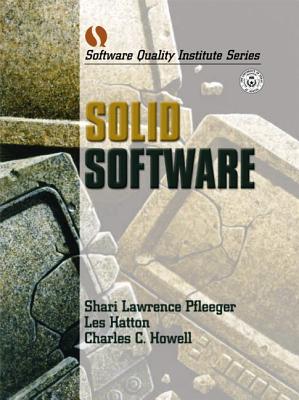
Solid Software (Out of print)
| AUTHOR | Howell, Charles; Pfleeger, Shari; Howell, Charles C. et al. |
| PUBLISHER | Prentice Hall (07/02/2001) |
| PRODUCT TYPE | Paperback (Paperback) |
No large software system will ever be perfect, but decision-makers need better ways to evaluate software quality -- especially in software that is business-critical, mission-critical, or utilized in life-or-death environments. In this book, three leading software quality consultants present practical techniques for projecting software quality and robustness in any software system or software-intensive product. Unlike other books, this one provides a business context, helping decision-makers make intelligent, responsible tradeoffs. KEY TOPICS: The authors help decision-makers understand what levels of quality and robustness are reasonable to expect at every stage of the software lifecycle, including development, deployment, and maintenance. They present best-practices techniques for projecting software quality, and assessing systems in production. Solid Software presents many real-world examples based on the authors' extensive experience as software quality consultants, and shares the insights of key software decision-makers throughout the U.S. in Europe.MARKET: For all software designers, system engineers, regulators, project/program managers, and chief technology officers who must judge quality and make tradeoffs in critical software and software-intensive products.
The practical guide to evaluating and improving the quality of mission-critical software.
Large software systems will never be perfect, but decision makers need better ways to evaluate and enhance software quality--especially where software is mission critical or used in life-or-death environments. Solid Software presents realistic techniques for analyzing and improving the quality and robustness of any software system or software-intensive product.
Solid Software isn't theoretical: it's a relentlessly practical decision maker's guide to making intelligent, responsible trade-offs that lead to the best software at the best cost.
- Understand what levels of quality are reasonable to expect at every stage of the software life cycle, including development, deployment, and maintenance
- Discover the key "design leverage points" that lead to robust software
- Learn sophisticated new ways to predict software quality and assess systems in production
- Make the most of hazard analysis, testing, design analysis, reviews, static code analysis, and other techniques
- Choose the best tools--and use them more effectively
Solid Software draws upon dozens of real-world examples, based on the authors' extensive experience as software quality consultants, and interviews with key software decision makers worldwide. Whether you're a developer, project manager, architect, executive, manager, or regulator, it's your single source for improving software quality--in the real world.
No large software system will ever be perfect, but decision-makers need better ways to evaluate software quality -- especially in software that is business-critical, mission-critical, or utilized in life-or-death environments. In this book, three leading software quality consultants present practical techniques for projecting software quality and robustness in any software system or software-intensive product. Unlike other books, this one provides a business context, helping decision-makers make intelligent, responsible tradeoffs. KEY TOPICS: The authors help decision-makers understand what levels of quality and robustness are reasonable to expect at every stage of the software lifecycle, including development, deployment, and maintenance. They present best-practices techniques for projecting software quality, and assessing systems in production. Solid Software presents many real-world examples based on the authors' extensive experience as software quality consultants, and shares the insights of key software decision-makers throughout the U.S. in Europe.MARKET: For all software designers, system engineers, regulators, project/program managers, and chief technology officers who must judge quality and make tradeoffs in critical software and software-intensive products.