
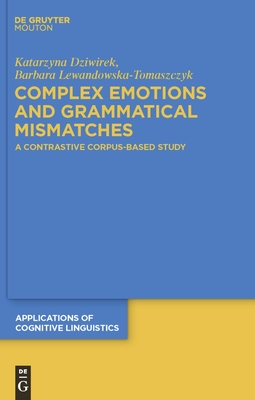
Complex Emotions and Grammatical Mismatches: A Contrastive Corpus-Based Study
| AUTHOR | Lewandowska-Tomaszczyk, Barbara; Dziwirek, Katarzyna |
| PUBLISHER | de Gruyter Mouton (07/16/2010) |
| PRODUCT TYPE | Hardcover (Hardcover) |
Nominated for the Best contribution to Slavic Linguistics/AATSEEL book award 2011
The concept of complex emotions is obviously polysemous. On the one hand, we can interpret it as a non-basic, non-prototypical, or culture-specific notion, on the other - and this is the interpretation we propose in this work - a complex emotion concept can be looked upon as a concept whose complexity emerges in interaction, due to the complex nature of its object. Our interpretation is thus construction-based, one in which meaning is not to be found exclusively in the lexical semantics of the term, but also in the, clearly meaning-laden, grammatical construction, e.g. a complement clause, expressing the object or cause of the emotion. The construal of a scene mapped on the form of a complex sentence involves the emotion that is unambiguously complex and not necessarily universal or prototypical. We argue throughout this book that cross-linguistic grammatical mismatches are a visible sign of conceptual and categorizational distinctions between the conceptualization of emotion in different languages and cultures. They also signal differences in what individual speakers consider salient in a portrayed scene.
We offer a contrastive corpus-based study of Polish and English emotion concepts and the linguistic patterns they enter. Our theoretical approach combines lexical semantics and cognitive linguistics and proposes a cognitive corpus linguistics methodology. It is a cognitive linguistic endeavor in which we analyze grammatical category mismatches and provide detailed semantic analyses of different complement choices of emotion predicates. We also discuss insights into Polish and English cultural values gleaned from the different underlying categorizations of emotions.
Combining theoretical analyses with pedagogical theory and classroom applications, this work breaks new ground and will reach audiences of linguists, teachers and students of Polish, teachers and students of English, translators, and other language researchers and practitioners.
Nominated for the Best contribution to Slavic Linguistics/AATSEEL book award 2011
The concept of complex emotions is obviously polysemous. On the one hand, we can interpret it as a non-basic, non-prototypical, or culture-specific notion, on the other - and this is the interpretation we propose in this work - a complex emotion concept can be looked upon as a concept whose complexity emerges in interaction, due to the complex nature of its object. Our interpretation is thus construction-based, one in which meaning is not to be found exclusively in the lexical semantics of the term, but also in the, clearly meaning-laden, grammatical construction, e.g. a complement clause, expressing the object or cause of the emotion. The construal of a scene mapped on the form of a complex sentence involves the emotion that is unambiguously complex and not necessarily universal or prototypical. We argue throughout this book that cross-linguistic grammatical mismatches are a visible sign of conceptual and categorizational distinctions between the conceptualization of emotion in different languages and cultures. They also signal differences in what individual speakers consider salient in a portrayed scene.
We offer a contrastive corpus-based study of Polish and English emotion concepts and the linguistic patterns they enter. Our theoretical approach combines lexical semantics and cognitive linguistics and proposes a cognitive corpus linguistics methodology. It is a cognitive linguistic endeavor in which we analyze grammatical category mismatches and provide detailed semantic analyses of different complement choices of emotion predicates. We also discuss insights into Polish and English cultural values gleaned from the different underlying categorizations of emotions.
Combining theoretical analyses with pedagogical theory and classroom applications, this work breaks new ground and will reach audiences of linguists, teachers and students of Polish, teachers and students of English, translators, and other language researchers and practitioners.