
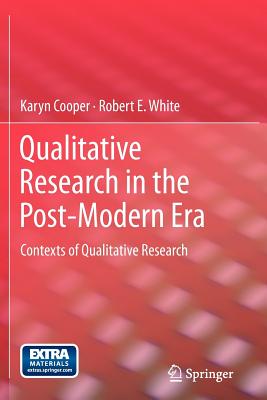
Qualitative Research in the Post-Modern Era: Contexts of Qualitative Research
| AUTHOR | Cooper, Karyn; White, Robert E. |
| PUBLISHER | Springer (11/17/2011) |
| PRODUCT TYPE | Paperback (Paperback) |
Qualitative Research is changing as a result of postmodern influences which have changed the way research is interpreted and understood. This has prompted questions which have been knocking at the door of qualitative research for some time now: Who is the researcher in this research account? How does the researcher relate to his/her research? How can the researcher who reads qualitative research relate to and understand the nuances and complexities in qualitative research? How can this volume help us to, not only describe, effect and manage change, but help us to understand, imagine and affect policies, practices and procedures related to research? What can we learn from researchers at the top of their stride who have struggled in order to develop qualitative research?
The book includes illustrative interviews with world famous scholars. William Pinar, Norman Denzin, Henry Giroux, Zygmunt Bauman and Maxine Greene invite the student to engage reflectively and to figure out the rudiments and connections of research methodology and methods for theses.
The developed so called "The Five Contexts" serves as a theoretical framework for conducting, understanding and interpreting qualitative research in a variety of disciplines in this post-modern era .
Qualitative Research is changing as a result of postmodern influences which have changed the way research is interpreted and understood. This has prompted questions which have been knocking at the door of qualitative research for some time now: Who is the researcher in this research account? How does the researcher relate to his/her research? How can the researcher who reads qualitative research relate to and understand the nuances and complexities in qualitative research? How can this volume help us to, not only describe, effect and manage change, but help us to understand, imagine and affect policies, practices and procedures related to research? What can we learn from researchers at the top of their stride who have struggled in order to develop qualitative research? This book includes illustrative interviews with world famous scholars. William Pinar, Norman Denzin, Henry Giroux, Zygmunt Bauman and Maxine Greene invite the student to engage reflectively and to figure out the rudiments and connections of research methodology and methods for theses .
This may be a set of volumes for which the field has been waiting. Gathered in one two-volume set are the voices and words of many of the giants in the field of qualitative research and/or critical perspectives.. If there is such a text anywhere else--with commentary, summary, author autobiographies, interviewee bibliographies, and accompanying video clips, I am unaware of it.... Equally useful, for students, researchers and teachers alike, are the authors' "five contexts" for grasping this complex and dynamic history.. These five contexts represent a major contribution to ways of thinking about research methods and their more overarching paradigms. We are incredibly fortunate to be the recipients of this work, simply because it provides us with a fresh set of intellectual and mental constructs with which we can teach and doresearch. Yvonna S. Lincoln, Texas A&M University
Qualitative Research is changing as a result of postmodern influences which have changed the way research is interpreted and understood. This has prompted questions which have been knocking at the door of qualitative research for some time now: Who is the researcher in this research account? How does the researcher relate to his/her research? How can the researcher who reads qualitative research relate to and understand the nuances and complexities in qualitative research? How can this volume help us to, not only describe, effect and manage change, but help us to understand, imagine and affect policies, practices and procedures related to research? What can we learn from researchers at the top of their stride who have struggled in order to develop qualitative research?
The book includes illustrative interviews with world famous scholars. William Pinar, Norman Denzin, Henry Giroux, Zygmunt Bauman and Maxine Greene invite the student to engage reflectively and to figure out the rudiments and connections of research methodology and methods for theses.
The developed so called "The Five Contexts" serves as a theoretical framework for conducting, understanding and interpreting qualitative research in a variety of disciplines in this post-modern era .