
ISBN 9798329469257 is currently unpriced. Please contact us for pricing.
Available options are listed below:
Available options are listed below:
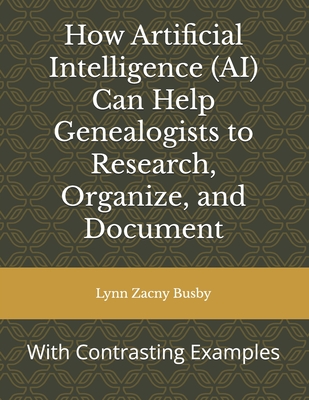
How Artificial Intelligence (AI) Can Help Genealogists to Research, Organize, and Document: With Contrasting Examples
| AUTHOR | Busby, Lynn Zacny |
| PUBLISHER | Independently Published (06/27/2024) |
| PRODUCT TYPE | Paperback (Paperback) |
Description
Artificial Intelligence (AI) has been integrated into our lives for over a decade, often under the guise of an "assistant." These assistants subtly enhance our experiences by making automated suggestions tailored to our interests. For instance, Netflix recommends movies you might enjoy, Alexa provides the current temperature, Facebook displays ads based on your recent inquiries, Google answers your voice queries without requiring typing, and Ancestry.com offers hints about your family tree.
Recently, AI has become more prominent and accessible. Now, anyone with a computer can directly ask AI to generate text, receiving responses almost instantly. These responses are not only quick but also spell-checked, grammatically correct, and punctuated properly.
However, it's important to note that while AI always provides a response, it is not always factual. AI generates answers that may sound logical but can lack a basis in reality, a phenomenon known as "hallucination." Given this tendency, can AI still be beneficial to genealogists who prioritize accuracy and the citation of original documents?
Despite its occasional inaccuracies, AI can be a valuable tool for genealogists. It can assist in organizing research, suggesting potential sources, and providing contextual information that might lead to further discoveries. The key is to use AI as a supplementary tool, verifying its suggestions with primary sources and documented evidence. This approach ensures that AI enhances genealogical research without compromising its integrity.
Recently, AI has become more prominent and accessible. Now, anyone with a computer can directly ask AI to generate text, receiving responses almost instantly. These responses are not only quick but also spell-checked, grammatically correct, and punctuated properly.
However, it's important to note that while AI always provides a response, it is not always factual. AI generates answers that may sound logical but can lack a basis in reality, a phenomenon known as "hallucination." Given this tendency, can AI still be beneficial to genealogists who prioritize accuracy and the citation of original documents?
Despite its occasional inaccuracies, AI can be a valuable tool for genealogists. It can assist in organizing research, suggesting potential sources, and providing contextual information that might lead to further discoveries. The key is to use AI as a supplementary tool, verifying its suggestions with primary sources and documented evidence. This approach ensures that AI enhances genealogical research without compromising its integrity.
Show More
Product Format
Product Details
ISBN-13:
9798329469257
Binding:
Paperback or Softback (Trade Paperback (Us))
Content Language:
English
More Product Details
Page Count:
138
Carton Quantity:
28
Product Dimensions:
8.50 x 0.30 x 11.00 inches
Weight:
0.74 pound(s)
Country of Origin:
US
Subject Information
BISAC Categories
Reference | Genealogy & Heraldry
Descriptions, Reviews, Etc.
publisher marketing
Artificial Intelligence (AI) has been integrated into our lives for over a decade, often under the guise of an "assistant." These assistants subtly enhance our experiences by making automated suggestions tailored to our interests. For instance, Netflix recommends movies you might enjoy, Alexa provides the current temperature, Facebook displays ads based on your recent inquiries, Google answers your voice queries without requiring typing, and Ancestry.com offers hints about your family tree.
Recently, AI has become more prominent and accessible. Now, anyone with a computer can directly ask AI to generate text, receiving responses almost instantly. These responses are not only quick but also spell-checked, grammatically correct, and punctuated properly.
However, it's important to note that while AI always provides a response, it is not always factual. AI generates answers that may sound logical but can lack a basis in reality, a phenomenon known as "hallucination." Given this tendency, can AI still be beneficial to genealogists who prioritize accuracy and the citation of original documents?
Despite its occasional inaccuracies, AI can be a valuable tool for genealogists. It can assist in organizing research, suggesting potential sources, and providing contextual information that might lead to further discoveries. The key is to use AI as a supplementary tool, verifying its suggestions with primary sources and documented evidence. This approach ensures that AI enhances genealogical research without compromising its integrity.
Recently, AI has become more prominent and accessible. Now, anyone with a computer can directly ask AI to generate text, receiving responses almost instantly. These responses are not only quick but also spell-checked, grammatically correct, and punctuated properly.
However, it's important to note that while AI always provides a response, it is not always factual. AI generates answers that may sound logical but can lack a basis in reality, a phenomenon known as "hallucination." Given this tendency, can AI still be beneficial to genealogists who prioritize accuracy and the citation of original documents?
Despite its occasional inaccuracies, AI can be a valuable tool for genealogists. It can assist in organizing research, suggesting potential sources, and providing contextual information that might lead to further discoveries. The key is to use AI as a supplementary tool, verifying its suggestions with primary sources and documented evidence. This approach ensures that AI enhances genealogical research without compromising its integrity.
Show More