
Sloan Technology Series
| AUTHOR | Pool, Robert |
| PUBLISHER | Oxford University Press (07/29/1999) |
| PRODUCT TYPE | Paperback (Paperback) |
Description
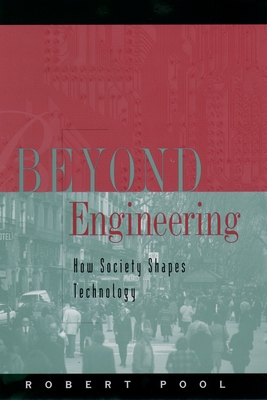
We have long recognized technology as a driving force behind much historical and cultural change. The invention of the printing press initiated the Reformation. The development of the compass ushered in the Age of Exploration and the discovery of the New World. The cotton gin created the conditions that led to the Civil War. Now, in Beyond Engineering, science writer Robert Pool turns the question around to examine how society shapes technology. Drawing on such disparate fields as history, economics, risk analysis, management science, sociology, and psychology, Pool illuminates the complex, often fascinating interplay between machines and society, in a book that will revolutionize how we think about technology.
We tend to think that reason guides technological development, that engineering expertise alone determines the final form an invention takes. But if you look closely enough at the history of any invention, says Pool, you will find that factors unrelated to engineering seem to have an almost equal impact. In his wide-ranging volume, he traces developments in nuclear energy, automobiles, light bulbs, commercial electricity, and personal computers, to reveal that the ultimate shape of a technology often has as much to do with outside and unforeseen forces. For instance, Pool explores the reasons why steam-powered cars lost out to internal combustion engines. He shows that the Stanley Steamer was in many ways superior to the Model T--it set a land speed record in 1906 of more than 127 miles per hour, it had no transmission (and no transmission headaches), and it was simpler (one Stanley engine had only twenty-two moving parts) and quieter than a gas engine--but the steamers were killed off by factors that had little or nothing to do with their engineering merits, including the Stanley twins' lack of business acumen and an outbreak of hoof-and-mouth disease. Pool illuminates other aspects of technology as well. He traces how seemingly minor decisions made early along the path of development can have profound consequences further down the road, and perhaps most important, he argues that with the increasing complexity of our technological advances--from nuclear reactors to genetic engineering--the number of things that can go wrong multiplies, making it increasingly difficult to engineer risk out of the equation. Citing such catastrophes as Bhopal, Three Mile Island, the Exxon Valdez, the Challenger, and Chernobyl, he argues that is it time to rethink our approach to technology. The days are gone when machines were solely a product of larger-than-life inventors and hard-working engineers. Increasingly, technology will be a joint effort, with its design shaped not only by engineers and executives but also psychologists, political scientists, management theorists, risk specialists, regulators and courts, and the general public.
Whether discussing bovine growth hormone, molten-salt reactors, or baboon-to-human transplants, Beyond Engineering is an engaging look at modern technology and an illuminating account of how technology and the modern world shape each other.
We tend to think that reason guides technological development, that engineering expertise alone determines the final form an invention takes. But if you look closely enough at the history of any invention, says Pool, you will find that factors unrelated to engineering seem to have an almost equal impact. In his wide-ranging volume, he traces developments in nuclear energy, automobiles, light bulbs, commercial electricity, and personal computers, to reveal that the ultimate shape of a technology often has as much to do with outside and unforeseen forces. For instance, Pool explores the reasons why steam-powered cars lost out to internal combustion engines. He shows that the Stanley Steamer was in many ways superior to the Model T--it set a land speed record in 1906 of more than 127 miles per hour, it had no transmission (and no transmission headaches), and it was simpler (one Stanley engine had only twenty-two moving parts) and quieter than a gas engine--but the steamers were killed off by factors that had little or nothing to do with their engineering merits, including the Stanley twins' lack of business acumen and an outbreak of hoof-and-mouth disease. Pool illuminates other aspects of technology as well. He traces how seemingly minor decisions made early along the path of development can have profound consequences further down the road, and perhaps most important, he argues that with the increasing complexity of our technological advances--from nuclear reactors to genetic engineering--the number of things that can go wrong multiplies, making it increasingly difficult to engineer risk out of the equation. Citing such catastrophes as Bhopal, Three Mile Island, the Exxon Valdez, the Challenger, and Chernobyl, he argues that is it time to rethink our approach to technology. The days are gone when machines were solely a product of larger-than-life inventors and hard-working engineers. Increasingly, technology will be a joint effort, with its design shaped not only by engineers and executives but also psychologists, political scientists, management theorists, risk specialists, regulators and courts, and the general public.
Whether discussing bovine growth hormone, molten-salt reactors, or baboon-to-human transplants, Beyond Engineering is an engaging look at modern technology and an illuminating account of how technology and the modern world shape each other.
Show More
Product Format
Product Details
ISBN-13:
9780195129113
ISBN-10:
0195129113
Binding:
Paperback or Softback (Trade Paperback (Us))
Content Language:
English
More Product Details
Page Count:
368
Carton Quantity:
24
Product Dimensions:
6.15 x 1.01 x 9.22 inches
Weight:
1.15 pound(s)
Feature Codes:
Bibliography,
Index,
Price on Product
Country of Origin:
GB
Subject Information
BISAC Categories
Technology & Engineering | Social Aspects
Technology & Engineering | Applied Sciences
Technology & Engineering | Entrepreneurship
Accelerated Reader:
Reading Level:
0
Point Value:
0
Guided Reading Level:
Not Applicable
Dewey Decimal:
600
Library of Congress Control Number:
96034364
Descriptions, Reviews, Etc.
publisher marketing
We have long recognized technology as a driving force behind much historical and cultural change. The invention of the printing press initiated the Reformation. The development of the compass ushered in the Age of Exploration and the discovery of the New World. The cotton gin created the conditions that led to the Civil War. Now, in Beyond Engineering, science writer Robert Pool turns the question around to examine how society shapes technology. Drawing on such disparate fields as history, economics, risk analysis, management science, sociology, and psychology, Pool illuminates the complex, often fascinating interplay between machines and society, in a book that will revolutionize how we think about technology.
We tend to think that reason guides technological development, that engineering expertise alone determines the final form an invention takes. But if you look closely enough at the history of any invention, says Pool, you will find that factors unrelated to engineering seem to have an almost equal impact. In his wide-ranging volume, he traces developments in nuclear energy, automobiles, light bulbs, commercial electricity, and personal computers, to reveal that the ultimate shape of a technology often has as much to do with outside and unforeseen forces. For instance, Pool explores the reasons why steam-powered cars lost out to internal combustion engines. He shows that the Stanley Steamer was in many ways superior to the Model T--it set a land speed record in 1906 of more than 127 miles per hour, it had no transmission (and no transmission headaches), and it was simpler (one Stanley engine had only twenty-two moving parts) and quieter than a gas engine--but the steamers were killed off by factors that had little or nothing to do with their engineering merits, including the Stanley twins' lack of business acumen and an outbreak of hoof-and-mouth disease. Pool illuminates other aspects of technology as well. He traces how seemingly minor decisions made early along the path of development can have profound consequences further down the road, and perhaps most important, he argues that with the increasing complexity of our technological advances--from nuclear reactors to genetic engineering--the number of things that can go wrong multiplies, making it increasingly difficult to engineer risk out of the equation. Citing such catastrophes as Bhopal, Three Mile Island, the Exxon Valdez, the Challenger, and Chernobyl, he argues that is it time to rethink our approach to technology. The days are gone when machines were solely a product of larger-than-life inventors and hard-working engineers. Increasingly, technology will be a joint effort, with its design shaped not only by engineers and executives but also psychologists, political scientists, management theorists, risk specialists, regulators and courts, and the general public.
Whether discussing bovine growth hormone, molten-salt reactors, or baboon-to-human transplants, Beyond Engineering is an engaging look at modern technology and an illuminating account of how technology and the modern world shape each other.
We tend to think that reason guides technological development, that engineering expertise alone determines the final form an invention takes. But if you look closely enough at the history of any invention, says Pool, you will find that factors unrelated to engineering seem to have an almost equal impact. In his wide-ranging volume, he traces developments in nuclear energy, automobiles, light bulbs, commercial electricity, and personal computers, to reveal that the ultimate shape of a technology often has as much to do with outside and unforeseen forces. For instance, Pool explores the reasons why steam-powered cars lost out to internal combustion engines. He shows that the Stanley Steamer was in many ways superior to the Model T--it set a land speed record in 1906 of more than 127 miles per hour, it had no transmission (and no transmission headaches), and it was simpler (one Stanley engine had only twenty-two moving parts) and quieter than a gas engine--but the steamers were killed off by factors that had little or nothing to do with their engineering merits, including the Stanley twins' lack of business acumen and an outbreak of hoof-and-mouth disease. Pool illuminates other aspects of technology as well. He traces how seemingly minor decisions made early along the path of development can have profound consequences further down the road, and perhaps most important, he argues that with the increasing complexity of our technological advances--from nuclear reactors to genetic engineering--the number of things that can go wrong multiplies, making it increasingly difficult to engineer risk out of the equation. Citing such catastrophes as Bhopal, Three Mile Island, the Exxon Valdez, the Challenger, and Chernobyl, he argues that is it time to rethink our approach to technology. The days are gone when machines were solely a product of larger-than-life inventors and hard-working engineers. Increasingly, technology will be a joint effort, with its design shaped not only by engineers and executives but also psychologists, political scientists, management theorists, risk specialists, regulators and courts, and the general public.
Whether discussing bovine growth hormone, molten-salt reactors, or baboon-to-human transplants, Beyond Engineering is an engaging look at modern technology and an illuminating account of how technology and the modern world shape each other.
Show More
Author:
Pool, Robert
Robert Pool writes for Discover and New Scientist and is author of Eves Rib. He lives in Arlington, Virginia.
Show More
List Price $29.99
Your Price
$29.69